 blog
Professional Drone Training for Beginners: A Complete Guide
Last Updated: November 21, 2026
Quick Summary
Professional drone training for beginners starts with earning a Transport Canada pilot certificate, which is legally required to fly a drone commercially in Canada. A complete course moves through four phases: ground school and theory, beginner flight skills, advanced operations and flight review, and professional readiness. Choose a flight school that includes supervised flight time, not theory alone.
- In Canada, you cannot legally fly a drone commercially without a Transport Canada pilot certificate.
- Basic operations cover flights away from people and controlled airspace; advanced operations require a flight review.
- Start lessons on a multirotor in an open field with an instructor and a clear drill each session.
- A cheap online theory course with no supervised flight time can leave you unprepared for the practical assessment.
- Ask for a written cost breakdown in Canadian dollars before committing to any provider.
Table of Contents
- Drone Pilot Certification: What Beginners Must Know First
- Beginner Drone Flying Lessons That Build Real Skills
- Choosing a Drone Flight School in Canada
- What a Professional Drone Pilot Course Covers
- Frequently Asked Questions
Drone Pilot Certification: What Beginners Must Know First
Professional drone training for beginners starts with one hard fact: in Canada, you cannot legally fly a drone commercially without a pilot certificate from Transport Canada. This guide covers the certification path, the flight skills that matter, and how to pick a flight school.
Drone pilot certification in Canada splits into two levels. Basic operations cover flights away from people and controlled airspace. Advanced operations let you fly closer to people and in more complex environments, and require a flight review with a trained reviewer. Both start with a written exam and demand real ground school study of air law, air traffic rules, and airspace.
For the full step-by-step path, read our guide on how to become a certified drone pilot, our walkthrough of 6 steps to Transport Canada RPAS certification, or our 5-step path to earning your drone pilot certificate.
Beginner Drone Flying Lessons That Build Real Skills
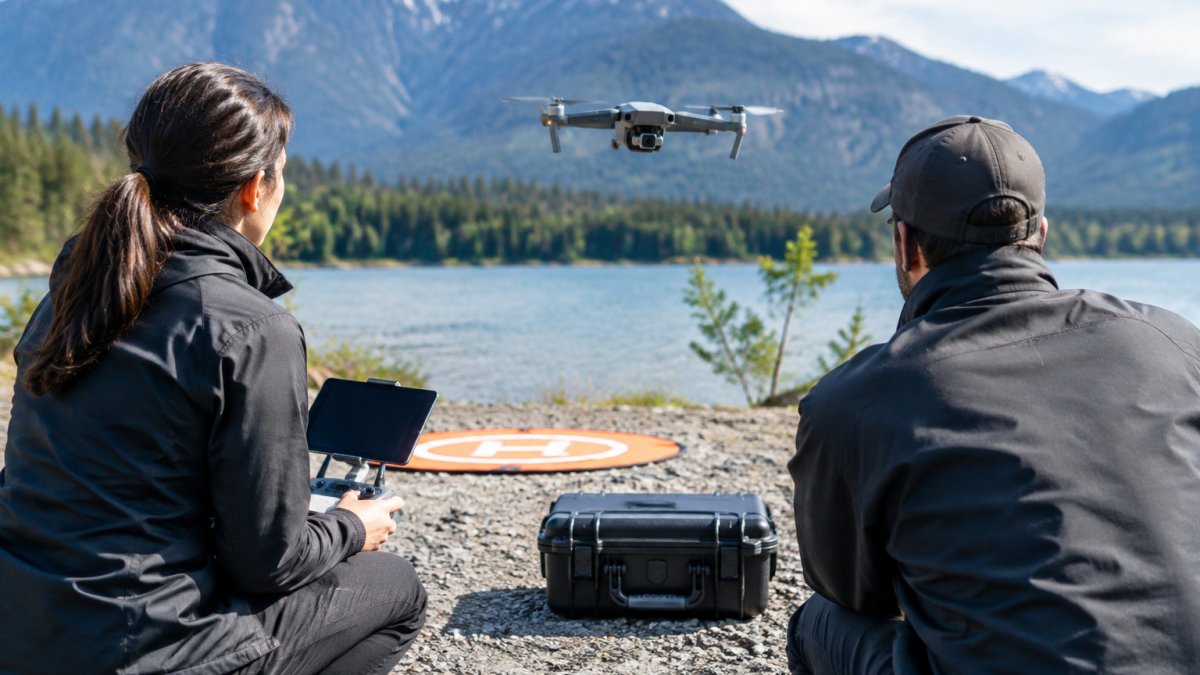
Lessons should start on a multirotor in an open field, with an instructor beside you and a clear drill for each session. Good beginner drone flying lessons cover takeoff, landing, hovering, and maneuvering first.
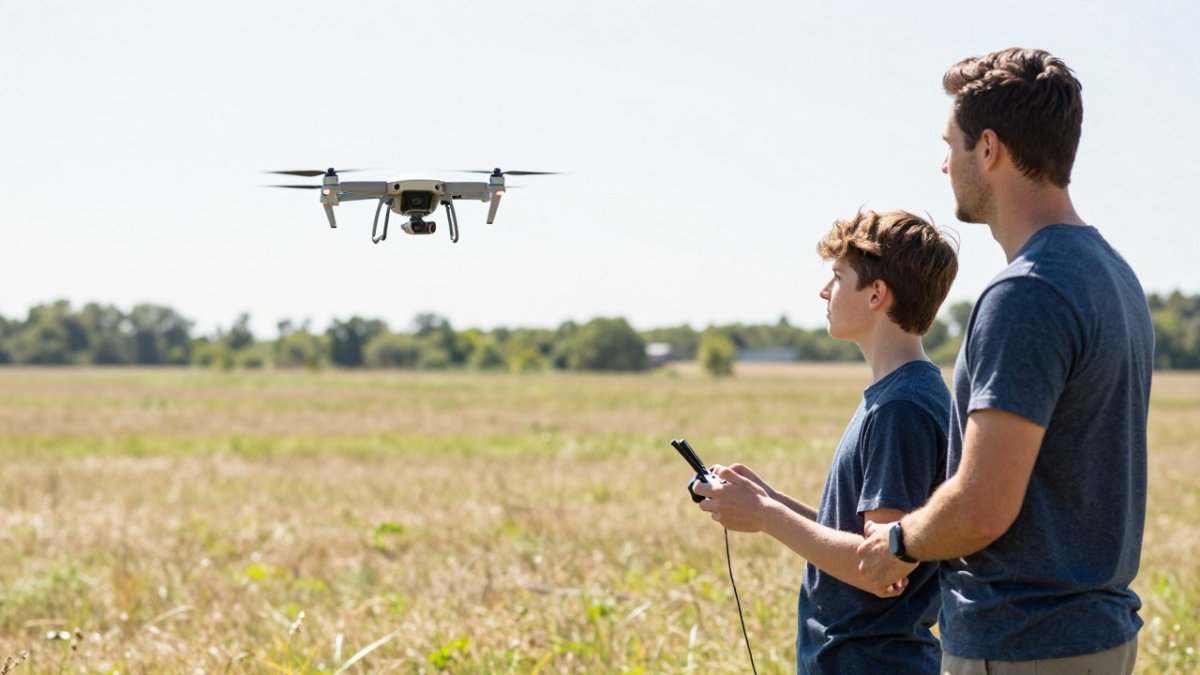
A common mistake is jumping to aerial photography before the basics are automatic. Fly the same exercise until the drone controls feel boring. Then add wind, obstacles, and a second flight mode.
Choosing a Drone Flight School in Canada
Beginners face several realistic training pathways; the right choice depends on how you learn, your budget, and how soon you need to fly commercially.
Self-study plus a flight review. You buy a ground-school text or online theory course, study the Transport Canada knowledge requirements, write the exam, and book a flight review. It is the lowest-cost route and works for disciplined learners, but gives no supervised stick time before the review.
Online ground school. A structured online course covers air law, airspace, flight planning, and safety in a fixed sequence, usually with practice exams. It fixes the sequencing problem of pure self-study but still leaves practical flight skills to you. Ask whether it includes a flight-review booking or only theory.
In-person ground school plus supervised flights. A school delivers theory in a classroom or hangar and pairs it with instructor-led flight sessions. You get real-time correction, which shortens the period where bad habits form. This is the middle-cost option and the most common path for beginners who intend to work professionally.
Costs vary by provider, so ask for a written breakdown in Canadian dollars before you commit. A complete budget should separate ground-school fees, the Transport Canada written exam fee, flight-review fees, instructor hourly rates, aircraft rental or your own drone costs, and any simulator or software subscriptions. Comparing these costs alongside the school’s approach to instruction can clarify what is included in your training, while Rexair offers a useful next step in considering how to choose a flight school.
Use this checklist when you evaluate any provider:
- Instructor experience: Who teaches, and do they hold the certificate level you are training for?
- Hands-on flight time: How many supervised hours are included, and on what aircraft?
- Curriculum: Does it cover air law, airspace rules, aviation regulations, flight planning, and safety and responsible operation as named topics?
- Exam preparation: Are practice exams and review sessions included?
- Flight review: Is the review booked through the school, and who conducts it?
- Support after certification: Can you get help with recency, compliance, and advanced operations later?
- Assessment: How is your progress measured between sessions?
Watch out: a cheap online theory course with no supervised flight time can leave you unprepared for the practical assessment, so confirm the flight-review arrangement in writing before you pay.
Not sure what the time commitment looks like? Our breakdown of how long drone pilot training takes covers the realistic timeline from enrollment to certification.
What a Professional Drone Pilot Course Covers
A professional course should take you from first flight to work-ready in visible stages, not just list topics. Expect four phases.
Phase 1, Ground school and theory. Air law, airspace rules and restrictions, aviation regulations, flight planning, meteorology basics, and safety and responsible operation. This is what the Transport Canada written exam tests, and where most beginners underestimate the study volume.
Phase 2, Beginner flight skills. Takeoff, landing, hovering, and maneuvering on a multirotor in an open field, with a drill for each session. Fly the same exercise until the controls feel boring, then add wind, obstacles, and a second flight mode. Simulator time between sessions builds muscle memory cheaply.
Phase 3, Advanced operations and flight review. Flying closer to people and in controlled airspace, plus the practical assessment with a trained reviewer. Supervised instruction pays off here, because a reviewer corrects habits self-taught pilots carry into the assessment.
Phase 4, Professional readiness. Connecting skills to real work: mapping and surveying, infrastructure inspection, and aerial photography. A course that stops at certification leaves you to bridge this gap alone, so ask whether the provider covers mission planning, data handling, and the software workflows your target work requires.
Equipment matters during training. A beginner aircraft that is stable and repairable beats a high-end platform you are afraid to crash. Budget for spare propellers, extra batteries, a controller you can grow into, and a simulator or post-flight software subscription if your specialty needs one. Confirm what the school supplies and what you must bring.
For a detailed example of advanced content, see our guide to expert drone operation training for geospatial technology.
At BlackHawk Aeronautical Solutions Inc., we offer one-on-one drone training. For current details on training options and pricing, contact us or visit our website for a quote.
A professional course moves through four visible phases from first flight to work-ready.
| Phase | Focus | Key details |
|---|---|---|
| Phase 1 | Ground school and theory | Air law, airspace rules, regulations, flight planning, meteorology, safety |
| Phase 2 | Beginner flight skills | Takeoff, landing, hovering, maneuvering; simulator time builds muscle memory |
| Phase 3 | Advanced operations and flight review | Flying closer to people and controlled airspace; practical assessment |
| Phase 4 | Professional readiness | Mapping and surveying, infrastructure inspection, aerial photography |
Certification is only the start. The pilots who get hired are the ones who can fly precisely, plan safely, and document their work. BlackHawk Aeronautical Solutions Inc. builds training around one-on-one instruction, flight review preparation, and the operational discipline that commercial clients expect. Get started with BlackHawk Aeronautical Solutions Inc. and turn your beginner skills into a professional drone career.
Frequently Asked Questions
What certification do you need to fly a drone professionally?
In Canada, commercial drone work requires a drone pilot certificate from Transport Canada. Pilots flying basic operations need the Basic Pilot Certificate, earned by passing an online exam. Advanced operations, which include flying near people or in controlled airspace, require the Advanced Pilot Certificate plus a flight review with a certified flight reviewer. A professional drone pilot course should prepare you for both the written exam and the practical assessment.
Do beginner drone flying lessons include hands-on flight practice?
Quality beginner drone flying lessons combine theory with real stick time. Look for a drone flight school that covers air law, airspace rules and flight planning, then puts you on the controls for takeoff, landing and maneuvering exercises. Look for providers that offer supervised flight practice so you build flight skills before your practical assessment rather than learning them for the first time on exam day.
How long does it take to get a drone pilot certificate?
Timelines vary by training route and how quickly you pass the online exam. A structured drone pilot course typically covers ground school and flight practice over several sessions, with the flight review scheduled once your knowledge and skills are ready. Some beginners finish within weeks; others spread training over a few months around work. Ask your provider how they structure the drone pilot certification path and what support you get with exam preparation and paperwork.