 Ultimate guide
How to Become a Certified Drone Pilot: A Complete Guide
Last Updated: November 6, 2026
Quick Summary
To become a certified drone pilot in Canada, you earn a Transport Canada Pilot Certificate by passing an online knowledge exam through the Drone Management Portal. The Basic certificate covers recreational and most commercial flights in uncontrolled airspace, while the Advanced certificate, which adds a flight review, is required for controlled airspace, flying near people, or certified aerodromes.
- Canadian pilots hold a Pilot Certificate, while American pilots hold a Remote Pilot Certificate under Part 107.
- The Basic exam has 35 questions in 65 minutes with a 65% pass mark and no flight review.
- The Advanced exam has 50 questions in 60 minutes with an 80% pass mark plus a required flight review.
- The flight review is a skills test assessing maneuvers like controlled hover and emergency descent.
- Advanced certificate holders must meet recency requirements to keep their flight authority current.
Table of Contents
- Canada Versus the US: Which Drone Certification Applies to You
- The Basic Drone Pilot Certificate: Who It Covers and How to Earn It
- The Advanced Drone Pilot Certificate: When You Need It and What Changes
- Choosing the Right Certificate for Your Planned Flight Operations
- Drone Pilot Training: Ground School, Study Plans, and Exam Preparation
- Registering Your Drone and Meeting Eligibility Requirements
- How Long to Get a Drone Pilot Certificate: Timeline and Costs
- After Certification: Flight Reviews, Renewal, and Staying Compliant
- Booking Professional Drone Pilot Training with BlackHawk
- Frequently Asked Questions
Canada Versus the US: Which Drone Certification Applies to You
If you have watched American drone tutorials online, you have probably encountered rules that do not apply to you. A certified drone pilot in Canada follows a completely different framework than a remote pilot in the United States, and mixing the two up is the most common mistake we see from newcomers. In Canada, Transport Canada regulates all Remotely Piloted Aircraft Systems under the Canadian Aviation Regulations. The terminology alone should tip you off: Canadian pilots hold a Pilot Certificate, while American pilots hold a Remote Pilot Certificate.
The practical differences matter more than the names. Canadian certification splits into Basic and Advanced tiers based on where and how you fly. The US system uses a single Part 107 certificate for commercial operations. Canadian rules also require drone registration for anything above 250 grams, plus recency requirements that US rules handle differently.
Here is the short version: if you plan to fly in Canada, study Transport Canada's RPAS rules and ignore FAA guidance entirely. If you fly in both countries, you will need credentials from both regulators. This guide from BlackHawk Aeronautical Solutions Inc. focuses on the Canadian pathway, because that is where your operations, clients, and legal obligations sit.
The Basic Drone Pilot Certificate: Who It Covers and How to Earn It
The Basic drone pilot certificate covers recreational flying and most commercial operations conducted in uncontrolled airspace, away from people and outside certified aerodromes. It is the entry point for most new pilots, and earning it is genuinely achievable without formal ground school.
Transport Canada sets minimum age requirements for the Basic certificate, so confirm the current rule on its official website before registering for the online exam through the Drone Management Portal.
The Basic exam is a multiple-choice knowledge exam covering air law, airspace classification, meteorology, flight operations, and radiotelephony basics. Check Transport Canada's current exam details before you register.
One detail most guides skip: the Basic certificate is tied to the drone category you fly. Subcategories exist for different operating environments, so confirm which one matches your intended flights before you sit the exam.
If you want a structured walkthrough of the entire process, from portal registration to certificate issuance, our team has put together a step-by-step guide on how to complete Transport Canada RPAS certification.
The Advanced Drone Pilot Certificate: When You Need It and What Changes
The advanced drone pilot certificate is generally required for operations in controlled airspace, near people, or within certified aerodromes. Confirm the requirements for your specific operations with Transport Canada.
Earning it involves a knowledge exam and a practical assessment. First, you pass the Advanced knowledge exam, which covers the material in greater depth than the Basic exam.
Second, you complete a flight review with a Transport Canada-certified flight reviewer (Complete a flight review for drones). The review assesses your practical piloting skills against a defined set of maneuvers and emergency scenarios. You cannot skip this step, and it is where many candidates stumble.
The Advanced certificate also carries recency requirements. Confirm the current recurrent training rules on Transport Canada's website, since lapsed recency affects your flight authority.
For pilots planning commercial operations in populated areas, the Advanced certificate is not optional. It is the baseline credential.
Choosing the Right Certificate for Your Planned Flight Operations
Choosing a certificate starts with one question: where will the drone physically fly? The answer determines everything else.
Use this decision framework before you register for any exam:
- Will you fly within 30 metres of bystanders? If yes, you need Advanced.
- Will you operate in controlled airspace? If yes, you need Advanced.
- Will you fly within a certified aerodrome? If yes, you need Advanced.
- Is your work strictly rural, uncontrolled airspace, and well away from people? Basic may cover you.
- Do you plan to offer commercial services to clients? Confirm the specific site conditions, because most urban commercial work requires Advanced.
A common mistake is earning the Basic certificate, then discovering a client's site sits inside controlled airspace. Upgrading means a second exam and a flight review, so map your intended operations first.
may find the Basic certificate sufficient. Commercial pilots serving construction, real estate, or infrastructure clients should confirm which certificate their operations require.
Drone Pilot Training: Ground School, Study Plans, and Exam Preparation
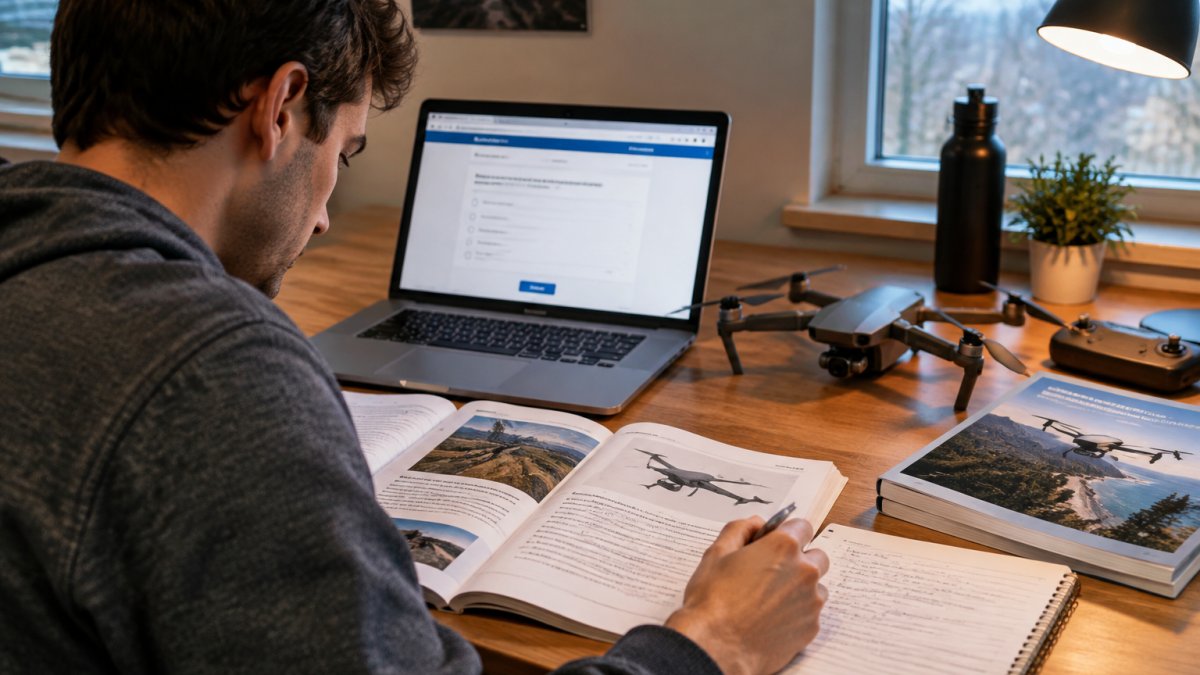
Self-study works for the Basic exam. For the Advanced exam and flight review, structured drone pilot training closes the gap between reading rules and applying them under pressure. The key is to study by topic weight, not by page count, and to practice under the same time pressure you will face on exam day.
Start by mapping the exam blueprint. Transport Canada publishes the knowledge requirements for both the Basic and Advanced pilot exams. Check the official guidance for the topic weighting before you plan your study time. If you have limited study time, spend it where the questions are.
A structured study plan can be built around the topics in the official requirements:
Week 1: Air law and regulations. Read Transport Canada's RPAS guidance end to end. Take notes on airspace classes, operating conditions, and the difference between controlled and uncontrolled airspace. Build a one-page reference sheet you can review daily. Week 2: Meteorology and flight operations. Focus on weather minimums, NOTAMs, and emergency procedures. Practice reading a METAR and TAF, because exam questions often present a weather report and ask you to make a go/no-go decision. Week 3: Practice tests. Sit full-length practice exams under timed conditions. Track which sections you miss consistently. A common pattern is that candidates lose points on airspace classification and radiotelephony, not on the headline rules they already know. Week 4: Flight review preparation. Practice the maneuvers a flight reviewer will assess, ideally with an instructor watching. This week matters most for Advanced candidates.
What most guides miss is that the flight review is a skills test, not a knowledge test. Practical skills such as controlled hover, emergency descent, and return-to-home procedures are assessed during the flight review. The flight reviewer is assessing whether you can fly safely and predictably, not whether you can recite a regulation.
For the Basic exam, self-study with the official Transport Canada study guide and a set of practice questions is usually enough. Check Transport Canada's current guidance on exam format, timing and fees before you book, and treat the first attempt seriously.
For the Advanced exam, structured ground school can be worth considering. The Advanced exam covers air law, flight operations, and radiotelephony in greater depth. A structured course can help you cover the exam syllabus and prepare for the flight review in one track.
Watch out: candidates sometimes book their flight review before they are ready, then struggle with a maneuver they never practiced. Confirm with your flight reviewer what maneuvers and emergency scenarios will be assessed, and practice those in the weeks before the review.
If you do not pass an exam, check Transport Canada's current rules for retakes and fees before rebooking through the Drone Management Portal. Use any feedback you receive to identify weak topics and rebuild your study plan around them.
Registering Your Drone and Meeting Eligibility Requirements
Drone registration requirements in Canada are set by Transport Canada and are separate from pilot certification. Check the current thresholds on the official website. You register the aircraft through Transport Canada's Drone Management Portal, receive a registration number, and affix it to the drone.
Eligibility requirements are set by Transport Canada and include age, registration, proof of competency, and medical fitness declarations. Confirm the current requirements on the official website before you apply.
Keep your registration current. If you sell the drone or change its configuration significantly, update the record.
How Long to Get a Drone Pilot Certificate: Timeline and Costs
Candidates often ask how long certification takes before they commit. The honest answer depends on which certificate you pursue.
Timelines vary with study pace and reviewer availability, so plan around your own schedule.
Costs break into three buckets: Transport Canada exam fees, drone registration fees, and optional training. Exam and registration fees are set by the regulator, so confirm current amounts on Transport Canada's official fee page before budgeting. Ground school and flight training vary by provider and are quoted per course.
| Certificate | Study Time | Exam | Flight Review | Typical Timeline |
|---|---|---|---|---|
| Basic | 5-10 hours | 35 questions, 65 min, 65% pass | Not required | 1-2 weeks |
| Advanced | 20-40 hours | 50 questions, 60 min, 80% pass | Required | 4-8 weeks |
Pricing depends on the scope of training and your certification goal. Contact BlackHawk Aeronautical Solutions Inc. for a quote tailored to your needs.
After Certification: Flight Reviews, Renewal, and Staying Compliant
Certification is not a finish line. Canada's RPAS framework includes ongoing compliance obligations that catch pilots off guard, and most guides stop at the exam. This section covers what competitors miss: the practical habits that keep your certificate usable and your operations legal.
Carry proof of competency. Keep your pilot certificate available during flight operations, and confirm with Transport Canada which forms of proof are accepted.
Keep registration current. Your drone registration is separate from your pilot certificate. If you sell the drone, change its configuration significantly, or transfer it to another operator, update the registration record through the Drone Management Portal. Flying an unregistered drone that requires registration is a violation even if your pilot certificate is valid.
Check airspace before every flight. Airspace is not static. Temporary flight restrictions, NOTAMs, and changes to controlled airspace boundaries can affect a site that was clear last week. Build a pre-flight routine that includes checking the current airspace classification and any active NOTAMs for your operating area. This is the single most common cause of inadvertent violations among newly certified pilots.
Maintain recency. Advanced certificate holders must meet recency requirements to keep flight authority current. Basic certificate holders have their own requirements, so confirm the current rules on Transport Canada's site rather than relying on any guide written before the last regulatory update.
Monitor rule changes. Transport Canada publishes updates to the RPAS rules, and staying current is your responsibility. Subscribe to Transport Canada's aviation safety notices or check the drone safety page periodically so you are not caught out by rule changes.
Respect operating limits. Compliance means maintaining visual line of sight unless you hold a specific waiver, respecting airspace authorizations, and following the operating conditions attached to your certificate. If you fly beyond visual line of sight or in a manner that requires an authorization, confirm you have the correct permission before launch.
Watch out: pilots who let their recency lapse may discover it during a client project. Calendar your recurrent training date and set a reminder well before it is due.
Troubleshooting common issues. If your certificate does not appear in the Drone Management Portal after you pass, allow time for processing and check that your profile details match your exam registration. If you need to book a flight review, contact a Transport Canada-certified flight reviewer directly, because scheduling lead time varies by region. If an application or registration update is delayed, keep a record of your submission and follow up through the portal rather than assuming it has been processed.
Staying compliant is mostly about routine. A short pre-flight checklist, a calendar reminder for recency, and a habit of checking airspace before each flight will keep your certificate working for you rather than becoming a source of surprises.
Booking Professional Drone Pilot Training with BlackHawk
Getting certified is a regulatory process, but becoming a genuinely capable certified drone pilot takes deliberate practice. The exam tests your knowledge of the rules, and the flight review tests your flying. Structured training with an experienced instructor can help you prepare for both.
At BlackHawk Aeronautical Solutions Inc., we offer one-on-one drone pilot training led by Mat L. Matthews, an experienced RPAS professional and instructor, with more than 15 years of experience in the drone industry.
Whether you are a project manager adding drone capability to a construction team or an aspiring commercial pilot building a career, contact us to discuss your certification goals.
Frequently Asked Questions
How do I become a certified drone pilot in Canada?
To become a certified drone pilot, you register with Transport Canada, pass the appropriate knowledge exam, and for Advanced operations complete a flight review with a certified reviewer. The Basic certificate requires only the online exam. The Advanced certificate adds a flight review and lets you fly in controlled airspace and near people under specific conditions. Check Transport Canada's current guidance on certificate validity and renewal.
What certification do I need to fly a drone commercially?
Commercial operations in Canada require either a Basic or Advanced drone pilot certificate depending on where and how you fly. Flying in controlled airspace, near bystanders, or over populated areas requires the Advanced certificate. Simple commercial work in uncontrolled airspace away from people can be done with the Basic certificate. Register your drone before any commercial flight.
What are the requirements for a basic drone pilot certificate?
Confirm the current requirements with Transport Canada, including age, drone registration, and the Basic knowledge exam. The exam covers airspace, regulations, flight safety, and meteorology.
How long does it take to become a certified drone pilot?
Timelines depend on study pace and reviewer availability. The Advanced certificate adds a flight review to the process.
Do I need a flight review to get a drone pilot certificate?
A flight review is required for the Advanced drone pilot certificate. Confirm the current requirements with Transport Canada.
Where can I find drone pilot training?
Transport Canada publishes a list of approved training providers and flight reviewers. Many commercial operators offer drone pilot training. When choosing a provider, ask about instructor experience and the training they cover.
The gap between holding a certificate and flying confidently on a client site is wider than most people expect. Close it with training built around Transport Canada's actual requirements and the flight review you will face. Get started with BlackHawk Aeronautical Solutions Inc. and earn your certification with instruction from Canada's elite drone professionals.