 Ultimate guide
How to Choose a Drone Service Provider for Your Next Project
Last Updated: November 20, 2026
Quick Summary
To choose a drone service provider, verify their Transport Canada Remote Pilot Certificate, drone registration, and proof of insurance before comparing quotes. Then match aircraft and sensors to your project scope, and request an itemized quote covering mobilization, flight operations, data processing, and deliverables.
- Ask for the certificate number and confirm the category matches your site's operation.
- Request a certificate of insurance confirming commercial flight operations coverage.
- Score every proposal against the same written checklist so you compare evidence.
- Request itemized quotes and compare totals only after confirming identical scope.
- Confirm in writing who owns raw imagery and how long the provider retains copies.
Table of Contents
- Start With Credentials: Drone Operator Qualifications That Matter
- Match Aircraft, Sensors, and Flight Operations to Your Project Scope
- The Drone Service Provider Checklist for Vetting Every Proposal
- Questions to Ask a Drone Service Provider Before You Sign
- Understand Drone Aerial Photography Cost in Canada Before You Compare Quotes
- Compare Service Tiers: One-Off Flights, Project Contracts, and Retainers
- Data Ownership, Deliverables, and Acceptance Criteria
- Contingency Planning: Weather, Turnaround Time, and Operational Resilience
- Request a Scoped Quote From BlackHawk Aeronautical Solutions Inc.
- Frequently Asked Questions
Start With Credentials: Drone Operator Qualifications That Matter
Choosing the right drone service provider starts with one question: can this operator legally fly, and can they prove it? In Canada, every commercial drone operation falls under Transport Canada's RPAS rules, and a legitimate provider will hand over credentials before you ask twice. This guide walks through the vetting process a client should run on any drone operator.
The basics to verify:
- A valid Remote Pilot Certificate for every pilot on the job
- Drone registration for each aircraft in the fleet
- RPAS certification at the correct category level for the operation
- A clean record of operating permissions and any waivers required for complex operations
A pilot flying sub-250g aircraft for basic operations holds different privileges than one flying a heavy-lift platform near infrastructure. Ask which certificate level applies to your site, and confirm it matches the aircraft they plan to deploy.
Transport Canada Certification and Operating Permissions
Transport Canada distinguishes between basic and advanced operations, and the certificate an operator holds should match the mission. Advanced operations, which include flying near people or in controlled airspace, require a certificate and approvals matching the level of risk involved (Drone operation categories and pilot certificates: Advanced operations).
Ask for the certificate number and the category it covers. A provider who hesitates here is a provider to skip. If you want to understand the certification path yourself, our guide on how to complete Transport Canada RPAS certification breaks down each step.
Transport Canada RPAS certification and flight review requirements
Insurance, Registration, and Proof of Coverage
Proof of insurance is not optional. Request a certificate of insurance naming liability coverage limits and confirming the policy covers commercial flight operations. Verify the drone registration numbers match the aircraft assigned to your project.
A provider who cannot produce a current certificate on request is telling you something.
Match Aircraft, Sensors, and Flight Operations to Your Project Scope
The right platform depends entirely on what you need to see. Aircraft capabilities, sensors, and camera resolution should map directly to your project scope, not to whatever the provider happens to own.
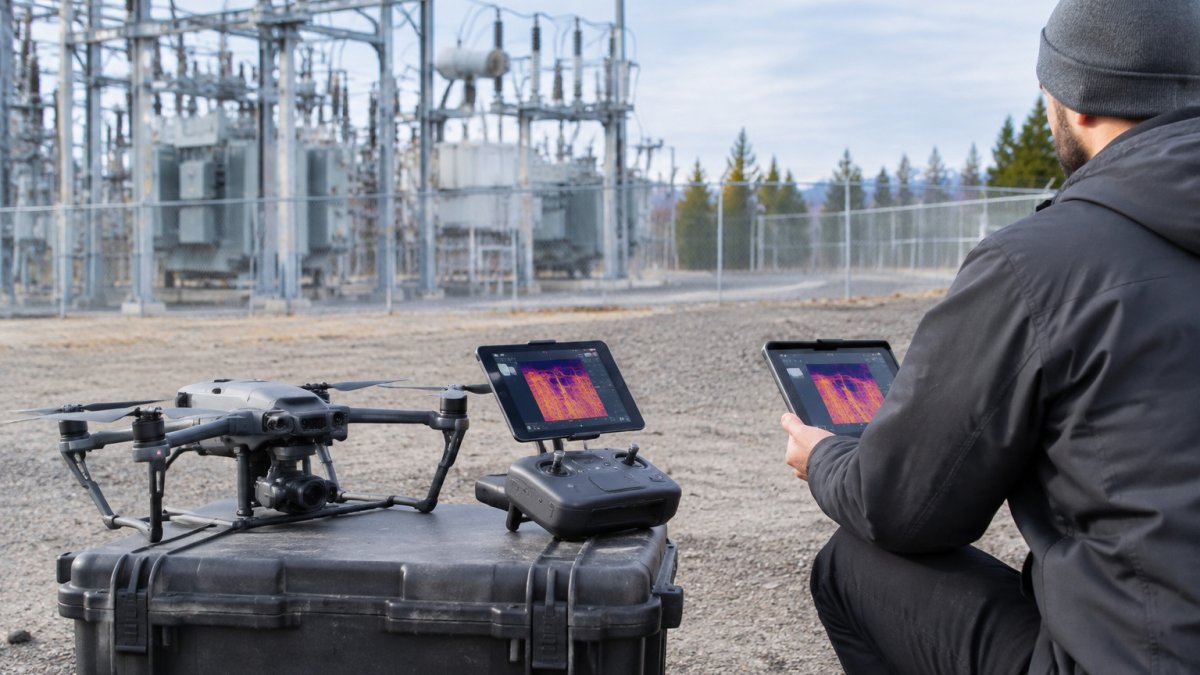
A thermal inspection of a substation needs a radiometric sensor, not a standard camera. Construction monitoring needs repeatable flight paths so progress images line up month over month.
Match the tool to the task:
| Project Need | Sensor and Aircraft Fit | What to Confirm |
|---|---|---|
| Construction progress | High-resolution RGB, repeatable flight paths | Same flight plan each visit |
| Industrial inspection | Thermal and zoom payloads | Radiometric data, not just video |
| Surveying and mapping | Survey-grade positioning, photogrammetry | Ground control points, accuracy spec |
| Real estate marketing | High-resolution camera, gimbal stability | Deliverable format and licensing |
| Live broadcast | Low-latency video transmission | Redundancy and backup aircraft |
For a deeper look at matching services to scope, read how to choose commercial drone video production services.
The Drone Service Provider Checklist for Vetting Every Proposal
A drone service provider checklist turns a sales conversation into a comparison. Score every proposal against the same criteria so you are comparing evidence, not impressions.
Use this to vet each bid:
- Remote Pilot Certificate number and category confirmed
- Drone registration and proof of insurance on file
- Advanced operations or waivers documented for the site
- Aircraft and sensors match the project scope
- Relevant industry experience and past projects shared
- References contacted and verified
- Data accuracy and measurement accuracy specifications stated
- Deliverables, reporting, and turnaround time defined in writing
- Data ownership, privacy, and retention terms clear
- Service area and weather conditions contingency addressed

Questions to Ask a Drone Service Provider Before You Sign
The best questions to ask a drone service provider expose gaps a polished proposal hides. Ask them in the same order every time, and note who answers confidently.
- Which certificate category covers this operation, and who is the pilot of record?
- Can you show proof of insurance and drone registration today?
- How do you handle airspace restrictions and site assessment before a flight?
- What is your weather contingency, and how do you communicate delays?
- What exactly do we receive, in what format, and by when?
- Who owns the raw data and imagery after the project ends?
- What is your quality assurance process for data accuracy?
- Can you provide references from projects like ours?
Once you have answers, how to book professional aerial inspection services covers the next step: turning a shortlist into a scheduled job.
Understand Drone Aerial Photography Cost in Canada Before You Compare Quotes
Drone aerial photography cost in Canada depends on several components that vary with scope, site, and deliverable depth. Treat any headline number with suspicion and instead ask every provider to quote against the same itemized structure so you can compare like-for-like.
The cost components that should appear in a credible quote:
- Mobilization and travel, distance to site, access time, and whether travel is billed per visit or per project. Remote service areas add both fuel and crew time.
- Flight operations, pilot hours, visual observer hours, and the number of flights required to cover the site. Complex operations requiring waivers or advanced certification carry higher crew costs.
- Equipment and sensors, the sensor type chosen, such as a standard camera or a thermal payload, affects both the cost and the processing burden.
- Data processing, photogrammetry, orthomosaic generation, point-cloud classification, and thermal analysis are labor-intensive. Ask whether processing is included or billed separately.
- Reporting and deliverables, a raw image folder is not the same deliverable as a formatted inspection report with annotated findings and a summary memo.
- Permits and airspace coordination, controlled airspace, restricted zones, or sites near airports may require additional coordination time and documentation.
- Contingency and rescheduling, weather buffers, standby days, and rush turnaround should be priced explicitly rather than discovered after a cancellation.
A common pattern is for the lowest bid to exclude processing, reporting, or the second visit a project actually needs. Request an itemized quote with each component listed separately, then compare the totals only after confirming every provider priced the same scope. If one quote is silent on a component, ask for it in writing before comparing.
Watch out: A quote that bundles everything into one line hides the cost of repeat flights and processing revisions, which are the two line items most likely to grow after the contract is signed.
For current pricing on your scope, request a scoped quote from BlackHawk Aeronautical Solutions Inc. on its website, and use the itemized structure above as the template for every provider you ask.
Compare Service Tiers: One-Off Flights, Project Contracts, and Retainers
Not every project needs the same engagement model. Matching the commercial structure to your actual cadence prevents overpaying for flexibility you never use.
| Service Tier | Best For | Trade-off |
|---|---|---|
| One-off flight | Single event, marketing shoot | Highest per-flight cost, no continuity |
| Project contract | Defined scope with start and end | Fixed deliverables, less flexibility mid-project |
| Retainer | Recurring monitoring or inspection | Predictable scheduling, commitment required |
Ask how each tier handles scheduling priority when weather conditions force a reschedule.
Data Ownership, Deliverables, and Acceptance Criteria
Data ownership is the clause most buyers forget to read, and it is where projects quietly lose control of sensitive site information. Confirm in writing who owns the raw imagery, the processed deliverables, and any derived 3D models or point clouds after the contract ends, and how long the provider retains copies on its own systems.
A practical ownership and retention checklist:
- Ownership transfer, state explicitly who holds raw and processed data after final payment, and whether the provider retains any rights.
- Retention period, ask how long files stay on provider servers after handoff, and whether deletion is confirmed in writing.
- Access controls, confirm who inside the provider organization can view your site data.
- Sensitive site information, for infrastructure, industrial, or security-sensitive sites, ask how the provider handles imagery before it is used in any portfolio or marketing.
Define acceptance criteria up front so a deliverable can be tested, not just viewed. Specify resolution, positional accuracy tolerances, file formats, coordinate systems, and reporting standards. For survey work, state the accuracy specification you require; for inspection work, state the defect annotation format you need. A deliverable you cannot use is a failed project, no matter how good the footage looks.
Build a formal acceptance step into the contract: a review window during which you can reject outputs that miss the stated criteria, and a correction period before final payment. Set a quality checkpoint before final payment so issues surface while the provider is still on the job.
Watch out: Without a written acceptance window, a provider can treat delivery as completion even when the accuracy or format does not match what your team needs.
If your team reports on site progress, whether drone mapping improves construction progress reporting explains how mapped data feeds those reports and what format downstream systems expect.
Contingency Planning: Weather, Turnaround Time, and Operational Resilience
Weather cancels flights, and a provider without a contingency plan cancels your schedule with it. Ask how they handle wind limits, precipitation, and airspace closures before you sign.
A resilient provider keeps backup aircraft, monitors forecasts, and communicates reschedules early. Turnaround time commitments should include a weather buffer, not assume perfect conditions every visit. Get the reschedule policy in writing: how much notice, at what cost, and how priority is handled when a clear day finally arrives.
This is where cheap providers quietly fail. The plan matters more than the promise.
Request a Scoped Quote From BlackHawk Aeronautical Solutions Inc.
The gap between a smooth aerial project and a stalled one usually comes down to vetting. Run every provider through the same checklist, demand proof of credentials and insurance, and define deliverables before anyone flies.
At BlackHawk Aeronautical Solutions Inc., we bring more than 15 years of professional drone experience to industrial inspections, aerial surveying and mapping, live drone broadcasting, and commercial aerial cinematography. Our team, led by an experienced RPAS professional, instructor and flight reviewer, works within Canadian aviation regulations, and our one-on-one RPAS training is designed to help your own staff stay compliant. Get started with BlackHawk Aeronautical Solutions Inc. and scope your next project with a provider that documents every credential before the first flight.
Frequently Asked Questions
What should I look for in a drone service provider?
Look for a valid Transport Canada remote pilot certificate, proof of liability insurance, and drone registration for every aircraft used. Ask about equipment and sensor capabilities, industry experience, and references from similar projects. Confirm how they handle data ownership, deliverables, and turnaround time. Ask any drone service provider to explain their flight planning, site assessment, and risk assessment process before quoting.
What questions should I ask before hiring a drone operator?
Ask to see pilot certification and insurance certificates, and confirm who owns the raw data and final deliverables. Ask how they handle weather delays, what their contingency plan is, and how quickly they can deliver processed files. Request a sample report or dataset from a past project. Also ask about airspace restrictions and operating permissions for your site, and whether they carry liability coverage that names your company.
How do I verify a drone service provider's qualifications?
Request the pilot's Transport Canada remote pilot certificate and confirm it matches the category of operation. Ask for the drone registration and a certificate of insurance showing liability coverage. Check that the provider can explain how they comply with Canadian Aviation Regulations, including any required waivers or operating permissions. References from past clients in your industry give you practical proof of their qualifications.
What insurance should a commercial drone service provider have?
A commercial drone service provider should carry liability insurance that covers drone flight operations, typically with limits appropriate to the project value and site risk. Ask for a certificate of insurance and confirm the policy covers the specific aircraft and sensors used on your project. If you are hiring for construction or industrial inspections, check whether the provider's coverage extends to third-party property damage and bodily injury.
How much does it cost to hire a drone service provider?
Pricing depends on project scope, location, sensor requirements, flight time, and processing needs. A simple aerial photography shoot costs less than a multi-day mapping or thermal inspection project. Ask for a quote that itemizes flight operations, data processing, and deliverables so you can compare providers fairly. Request current pricing directly from BlackHawk Aeronautical Solutions for an accurate estimate based on your site and requirements.
What should a drone services proposal include?
A strong proposal should list the aircraft and sensors to be used, pilot qualifications, insurance details, and the project workflow from site assessment to data delivery. It should define deliverables, file formats, accuracy targets, and turnaround time. Ask for a clear scope, assumptions, and a contingency plan for weather or airspace restrictions. A good proposal also states data ownership and retention terms.
How can I compare drone service providers?
Use a scorecard that rates credentials, insurance, equipment, relevant experience, data deliverables, turnaround time, and total cost. Ask each provider the same questions and request sample deliverables. Compare not just the quote total but what is included: raw data, processed reports, and follow-up support. A provider that explains its safety and quality assurance process clearly is usually the safer choice.